
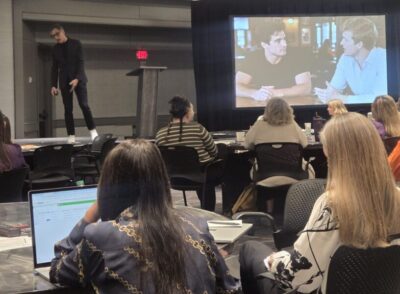
At the recent AMCI Regional Meeting in Atlanta, I had the opportunity to hear speaker Andy Christiansen.
His topic?
Minute to Meaning: The Leadership Power of Intentional Curiosity.
I’ll be very honest. I had not read the session description deeply, but the title certainly made me curious enough to scramble back down to the opening session.
And I had already been scrambling all morning.
From doing an F3 workout at 5:30A, to running back to shower, to grabbing my “grab and go” breakfast, to making the bus for the tour of the IHG Hotels & Resorts Design Center, to getting back to the hotel, running upstairs, grabbing my stuff, and taking it down to my car so I could leave immediately following my last speaking session.
I was ready to sit for a spell and listen to what Andy had to say.
After a brief story, Andy dug right into the idea that we have become a world that values transactions over relationships.
We have quit being curious about each other because we have gotten too dang busy.
We are too busy tracking conference attendance, website hits, email opens, member growth, and year-over-year trends.
Now, Andy did not mention any of those specific data points. His session was more about us as leaders in the workplace. But the more I listened, the more I thought about how relevant his message is to the way we often view membership.
One slide that really hit home was titled:
The Five Needs: What People Really Want.
They included:
Respect Me — Treat me fairly. Listen. Give credit.
Know Me — See the person behind the performance.
Guide Me — Set clear expectations. Give useful feedback.
Grow Me — Coach my strengths. Encourage development.
Trust Me — Give me autonomy, flexibility, and ownership.
How often do we fail to incorporate these needs within our membership experience?
I could cite so many examples of where associations fall short and fail to address the actual needs of the member.
Instead, we view that member as a registration.
A PAC donation.
A committee member.
A name badge.
A lapsed member.
Or one of the 82% who renewed last year.
Andy put it so well during his presentation:
“So, if people want to matter, why are we so bad at making them feel that way? Because most of us are incredibly busy managing the work.”
That line hit home.
As association professionals, we are very good at managing the work.
We manage programs.
We manage events.
We manage committees.
We manage invoices.
We manage renewals.
We manage board meetings.
We manage email campaigns.
But sometimes, in all that managing, we forget to be curious.
And if we want to build stronger associations, we have to learn to be more curious.
Not just the CEO.
Not just the membership director.
Not just the marketing team.
Everyone.
Membership is everyone’s job.
All the time.
In wrapping up his session, Andy shared several questions leaders can use to get to know employees better and begin building deeper relationships.
As I listened, I kept thinking how applicable those same questions are to association members, committee chairs, board members, sponsors, volunteers, and partners.
Questions like:
What’s top of mind?
What’s clear for you right now?
What are your expectations for this meeting?
If I could only do one thing to help you right now, what would it be?
What’s your greatest personal or professional challenge right now?
What’s causing you the most tension right now?
What’s made you smile lately?
Those are not complicated questions.
But they are meaningful questions.
They move us from transaction to relationship.
They remind us that a member is not just a data point in the AMS.
A member is a person with pressures, goals, frustrations, responsibilities, and hopes.
So whether you are trying to understand your members better, build a stronger committee culture, improve board engagement, or get to know a volunteer leader a little more deeply, maybe the starting point is simpler than we make it.
Slow down.
Ask better questions.
Be more curious.
It should not be about how much we can get from our members.
It should be about how well we understand them.
Because when members feel known, respected, guided, trusted, and supported in their growth, they are no longer just participating in an association. They belong to one.
Leave a Reply
You must be logged in to post a comment.