
It was just a few weeks ago that I wrote a blog post about how “weight is just a number.”
And in fact, there are many numbers that matter when it comes to tracking our overall health.
Over the last few months, there has been an additional reason why I needed to schedule several visits with my primary care provider, who, by the way, is a physician assistant.
Big shout-out to the American Academy of Physician Associates.
In my earlier blog, I mentioned my weight, BMI, blood sugar, cholesterol, and how all of those numbers were improving.
There was one number, however, that was going up.
And pretty drastically.
My provider was concerned.
That number was my PSA.
So, what is PSA?
A prostate-specific antigen, or PSA, test is a simple blood test that measures a protein produced by cells in the prostate gland. Small amounts of PSA naturally circulate in the bloodstream, which can make it a helpful baseline metric for men’s health.
While PSA is often discussed as a screening tool for prostate cancer, a PSA score is not a simple “good or bad” readout. It is more like a biological check-engine light. It can signal that something in the urinary or reproductive system may need a closer look.
When a PSA score comes back higher than normal, or increases quickly over a short period of time, it can point to an active change in the prostate. While a sudden jump naturally raises concerns about prostate cancer, non-cancerous conditions can also cause PSA levels to rise. Those may include inflammation or infection, benign prostatic hyperplasia, which is age-related prostate enlargement, recent vigorous exercise, or even recent medical procedures.
That is why doctors look not only at the number itself, but also how quickly it changes over time.
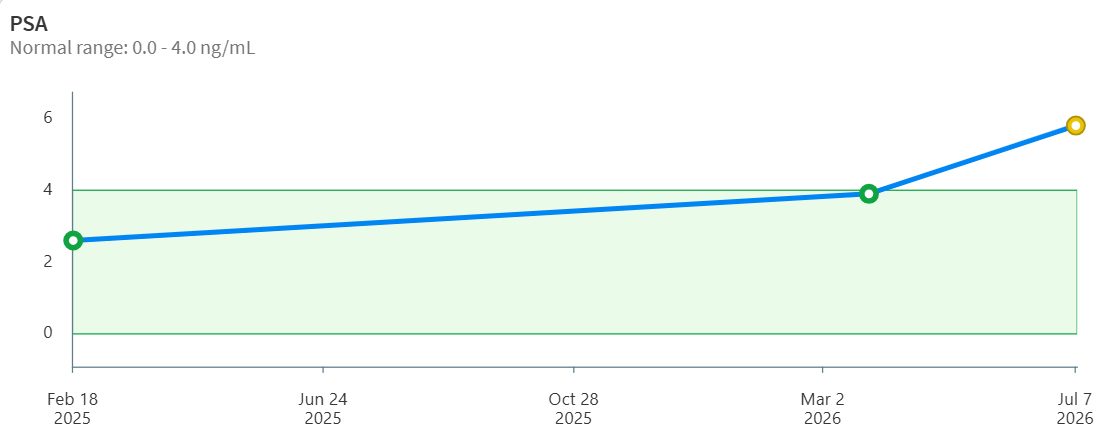
My annual physical from a year ago revealed that my PSA was 2.6 ng/mL. At my next physical earlier this year, it was 3.9 ng/mL. Keep in mind that the normal range is generally considered to be 0.0 to 4.0 ng/mL.
When I came in for a follow-up, my PSA had shot up to 5.8 ng/mL within about a four-month period.
Needless to say, Dr. Dan was concerned.
Along with my lab results came this message:
“I have gone ahead and gotten the ball rolling on a referral to urology for further evaluation since this can be potential evidence of prostate cancer. Don’t panic — the value isn’t that high and we are obviously catching this early in terms of how the PSA has increased.”
Now, I don’t know how you read things, but there might as well have been no other words in that message.
All I saw was the “C” word.
Cancer.
Yesterday, I finally had my appointment with the urologist.
And she was absolutely amazing.
Great bedside manner. Very informative. And more importantly, very calming and reassuring.
She explained that she was, of course, concerned about the recent spike, but that it was early. Then she walked me through the plan.
First, we would check my labs again to see whether the number had risen any more since my last blood work.
If the number was still higher than we wanted, we would schedule an MRI. The MRI could confirm an enlarged prostate, which is not unusual as men get older. Or it could show lesions. If lesions were found, they would use a more sophisticated MRI-guided process to identify them precisely and send samples for biopsy.
My heart was racing.
I wanted to immediately run down to the lab, get my blood drawn, and wait right there for the results.
Dr. Raines calmed me down and explained that if I had come in with a PSA of 15 ng/mL, she would not have started with blood work. She would have done an exam and immediately scheduled an MRI.
That helped.
Sort of.
Either way, I just wanted those numbers back.
This morning, after my swim, I received an email from MyChart saying my lab results were available. They had not even been reviewed by the doctor yet.
I am not going to lie.
I was freaking the you-know-what out as I logged in.
And what was awaiting me?
A lab report showing a PSA of 3.08 ng/mL.
Later, I received another message from my doctor confirming what I saw. She said it was great news, but that we should come back in about three months to confirm.
I was absolutely elated.
And I was even more thankful that I go for regular checkups.
I cannot imagine being the guy who has not been to the doctor in years and finally goes in because of frequent or painful urination, only to learn that his PSA is extremely elevated and there may be something much more serious going on.
Your health truly is a numbers game.
But you have to participate to know what those numbers are.
You have to schedule the appointment.
You have to get the blood work.
You have to read the results.
You have to ask the questions.
You have to follow up.
Because the goal is not to live in fear of every number.
The goal is to know your numbers early enough to do something about them.
Don’t wait until your final number is called.
By then, it may be much too late.
Leave a Reply
You must be logged in to post a comment.